Când au devenit codurile QR populare?
Eureka Seven
When Did QR Codes Become Popular?
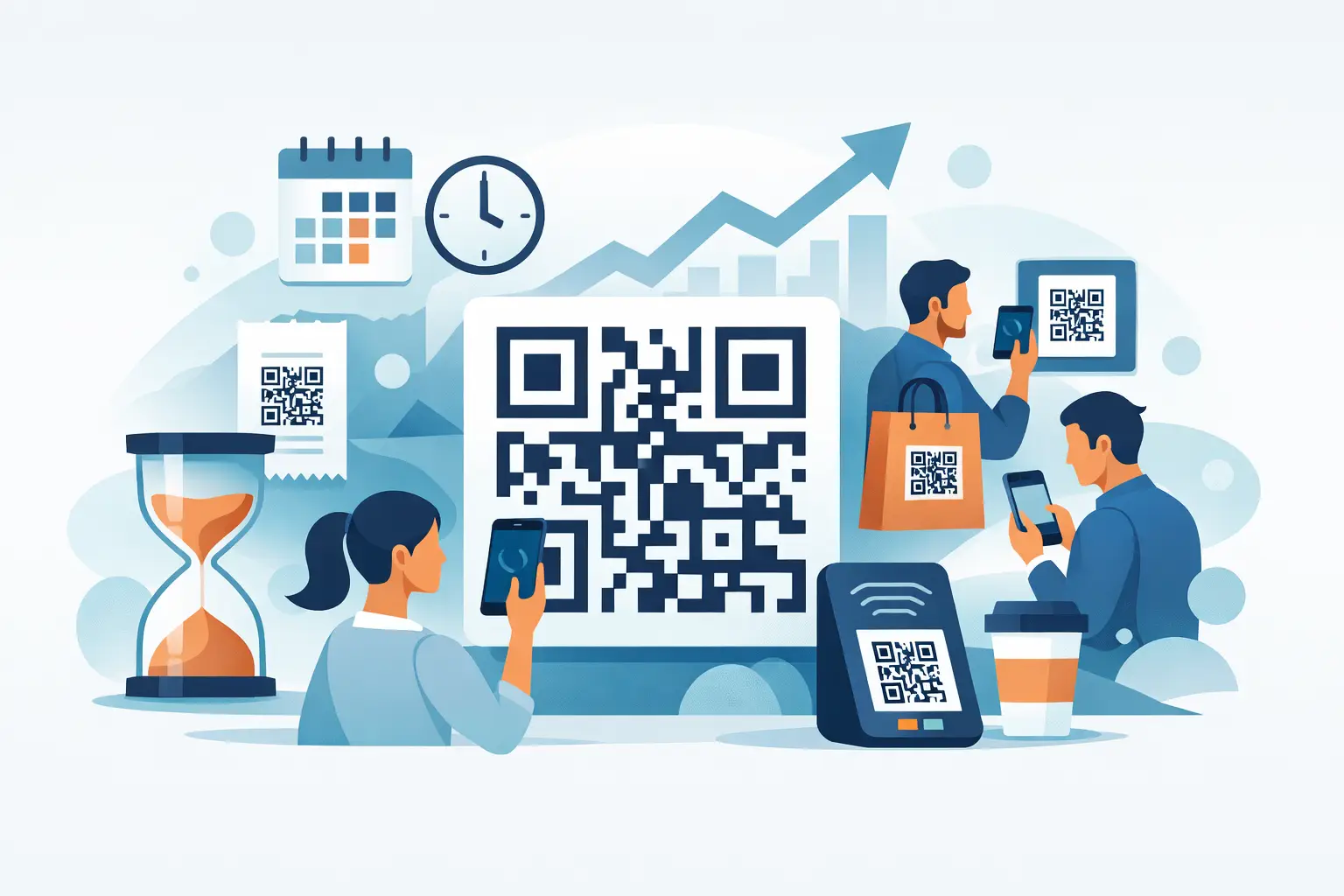
If you are asking when QR codes became popular, the short answer is this: they existed for years, but they became mainstream in the late 2010s and really took off in 2020 and 2021. That jump was not caused by one trend alone. It happened because smartphone cameras got better, scanning became easier, and businesses suddenly needed a fast way to connect physical spaces to digital actions.
For small businesses, marketers, and creators, that timing matters. It explains why QR codes went from something people ignored on posters and packaging to something customers now expect to see on tables, signs, mailers, business cards, and product labels.
When did QR codes become popular in the US?
When did QR codes become popular in the US?
QR codes were invented in Japan in the 1990s for tracking automotive parts. They were useful long before most American consumers cared about them. In the US, early public use showed up in ads, event materials, and product packaging during the 2000s and early 2010s, but adoption stayed uneven.
The problem was not the code itself. The problem was the experience. Many people had to download a separate app just to scan one. That added friction, and friction kills usage.
Things started shifting around 2017 and 2018, when major smartphone makers built QR scanning directly into native camera apps. Once users could point their phones at a code without extra steps, the technology became more practical. That was the first real move toward mass adoption.
Then came 2020. Restaurants needed touch-free menus. Offices needed low-contact check-ins. Retailers, healthcare providers, schools, and service businesses needed a simple way to move people from a physical place to online information. QR codes fit the moment perfectly. By then, consumers also understood how to use them, which made the jump much faster.
So if you want the cleanest timeline, it looks like this: QR codes were introduced in the 1990s, gained some business use in the 2000s, became much easier to scan in the late 2010s, and became widely popular during the pandemic era.
Why QR codes stayed niche for so long
Why QR codes stayed niche for so long
A lot of technologies arrive before the market is ready for them. QR codes are a good example.
In the early years, they solved a real problem, but mostly for industrial use. Later, marketers tried to use them for consumers, but the supporting habits were not there yet. Mobile internet was slower, camera quality varied, and many users did not trust random squares printed on signs. Even when a scan worked, the destination often disappointed people. Some codes led to desktop-only websites, broken pages, or generic homepages that gave users no reason to scan again.
That matters because popularity is not just about awareness. It is about repeated usefulness. People adopted QR codes once the result became predictable. Scan the code, get the menu. Scan the code, open the payment page. Scan the code, visit the profile or website. Simple action, clear outcome.
What made QR codes finally take off
What made QR codes finally take off
The biggest reason QR codes became popular is convenience. But convenience only counts when several pieces line up at once.
First, smartphone penetration became high enough that most customers already had a capable scanner in their pocket. Second, operating systems reduced the extra steps needed to use QR codes. Third, businesses found practical, everyday use cases instead of novelty campaigns.
This is where the technology matured. A QR code stopped being a gimmick on a billboard and became a utility. It gave businesses a quick bridge between offline attention and online action.
That shift changed how people thought about scanning. Instead of asking, "Why would I use this?" they started asking, "What happens if I scan it?"
When did QR codes become popular for businesses?
When did QR codes become popular for businesses?
For businesses, the answer is slightly different from consumer popularity. Companies had been using QR codes before most shoppers used them regularly. Operations teams, manufacturers, logistics groups, and some marketers saw the value earlier.
But QR codes became broadly popular for everyday business use around 2020. That is when local shops, restaurants, salons, real estate agents, fitness studios, event organizers, and service providers started adopting them at scale.
Why? Because they are low-cost, fast to create, and easy to place almost anywhere. A business can add one to a flyer, storefront, table tent, postcard, package insert, or trade show display without changing much else. For small teams, that matters. You do not need a big software rollout to make a link easier to access.
This is also why QR codes became popular with creators and solo brands. A printed code can send people straight to a portfolio, booking page, social profile, video, or product page without asking them to type a long URL.
The pandemic accelerated behavior that was already forming
The pandemic accelerated behavior that was already forming
It is tempting to say the pandemic made QR codes popular. That is partly true, but not the whole story.
The pandemic acted more like an accelerator than a starting point. By 2020, the technical barriers were already dropping. People had smartphones. Cameras could read codes quickly. Native scanning was common. Businesses just needed a stronger reason to use them.
That reason arrived fast. Contactless interactions were no longer a nice extra. They became operationally useful. Menus moved online. Forms moved online. Product information moved online. So did ticketing, registration, payments, and directions.
Once customers got used to scanning in those situations, the habit spread into normal marketing and communication. Even after the urgent need faded, the behavior stayed because it was efficient.
Why QR codes still work now
Why QR codes still work now
Some trends spike and disappear. QR codes did not, because they solve a basic access problem.
Typing a URL is slower than scanning. Searching for the right profile or page creates room for drop-off. A QR code shortens that path. That is the core reason it still works across print and physical spaces.
There is also flexibility. A code can support simple use cases like opening a homepage, but it can also point to a landing page, a menu, a signup form, a review request, a payment page, or a social destination. That range makes it useful for both one-person businesses and larger teams.
There are trade-offs, though. A QR code only works when the destination is worth the scan. If the linked page is slow, unclear, or not mobile-friendly, people will leave. Placement matters too. If the code is too small, badly printed, or shown in low light, scans will drop.
So while QR codes are popular, good results still depend on execution.
What this means for marketing today
What this means for marketing today
The popularity of QR codes changed one important thing for marketers and small businesses: you no longer need to teach most people what a QR code is. That lowers the barrier to using them in everyday materials.
Now the main question is not whether people know how to scan. It is whether your code gives them a clear reason to do it.
That reason should be obvious in the context. On packaging, it might be product details or setup instructions. On a business card, it might be contact info or a portfolio. On in-store signage, it might be a discount, menu, booking page, or product collection. On printed promos, it might be a direct path to your website or social profile.
This is where a simple tool matters. If you need to turn a link into something scannable fast, a utility-focused option like QRColor fits the way most businesses actually work. You have a destination, you need a code, and you want to use it right away.
Are QR codes still growing, or have they peaked?
Are QR codes still growing, or have they peaked?
They are no longer new, but that does not mean they have peaked. In many industries, QR codes have settled into a stable role as basic infrastructure for digital access.
That is usually a good sign. Mature tools last because they are practical, not because they are trendy. Email is not exciting, but it is useful. QR codes are heading into that same category.
Growth now is less about novelty and more about better use. Businesses are getting smarter about where they place codes, what they connect to, and how they fit into the customer journey. A code with no context underperforms. A code attached to a clear action can still perform very well.
If you have wondered when did QR codes become popular, the real answer is that popularity arrived in stages, but mainstream acceptance came when the scan became easy and the use case became obvious. That is why they are still here. And if you give people a fast, useful destination on the other side of the scan, they will keep using them.